
User manual · Objects & Properties
Reverb
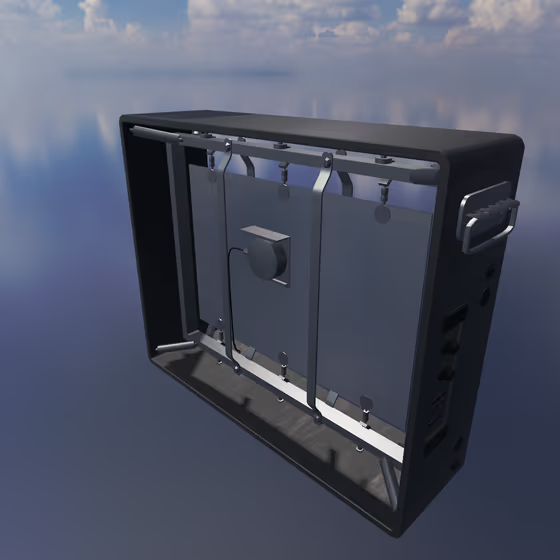
The Reverb FX places the audio routed through it into a simulated reverberant space, from tight studio rooms to enormous shimmering caverns. Like all FX, it receives audio via Delay Lines or its external input channel.
Reverb Properties#
- Mode: The reverb algorithm: Hall, Room, Plate, Spring 1, Spring 2, Shimmer 1, or Shimmer 2. Some of the parameters below apply only to certain modes; the panel shows the ones that are relevant to the selected mode.
- Pre-Delay: Time gap between the dry signal and the start of the reverb tail. This can help keep the source audible by separating it from the reverb in time.
- Size (Hall, Room, and Shimmer modes): Apparent size of the reverberant space. Larger values give longer, more spread-out echoes; smaller values give a tighter, smaller feel.
- Decay: How long the reverb tail takes to fade out. Short values are studio-tight; long values are cathedral-like.
- Damping Low: How quickly low frequencies fade in the tail. Higher values trim bass build-up for a clearer, less muddy reverb.
- Damping High: How quickly high frequencies fade in the tail. Higher values darken the reverb over time, like real rooms where treble is absorbed faster than bass.
- Mod Rate: Speed of the gentle pitch wobble inside the reverb tail. Subtle modulation keeps long tails from sounding sterile or metallic.
- Mod Depth: Depth of the pitch wobble inside the reverb tail. A value of 0 is dead-still, while high values produce an audible warble or chorus-like shimmer.
- Diffusion (Hall, Room, and Shimmer modes): How quickly individual echoes blur into a smooth wash. Low values preserve discrete reflections for a more "roomy" sound; high values give a thick, smeared cloud.
- Width: Stereo width of the reverb tail. A value of 0 collapses to mono, 1 is natural stereo, and values above 1 over-emphasize the side channel for an exaggerated stereo image.
- Shimmer Pitch (Shimmer modes): The interval by which to pitch-shift the feedback signal each pass. Positive values produce the classic "celestial" ascending-octave shimmer; negative values produce a moody descending-octave wash.
- Shimmer Amount (Shimmer modes): How much pitch-shifted feedback is mixed into the reverb tail. A value of 0 gives an ordinary tail, while higher values pile up shifted echoes for the classic celestial, cavernous shimmer effect.