
User manual · Objects & Properties
Grain Delay
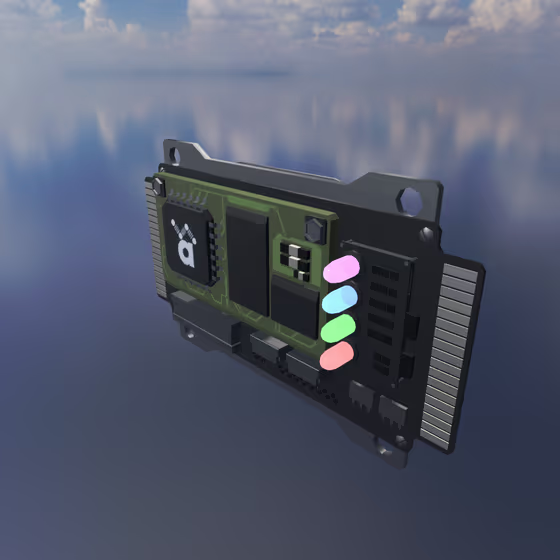
The Grain Delay FX chops the delayed signal into small "grains" that can be individually pitch-shifted, scattered in time, panned, and even reversed, producing anything from subtle shimmer to dense granular clouds. Like all FX, it receives audio via Delay Lines or its external input channel.
Grain Delay Properties#
- Tempo Sync: Enable this to provide a beat subdivision for the delay time instead of a raw time duration. When enabled, the Delay slider is replaced by the Sync Division selector.
- Delay: How long grains are delayed. Short values are tight and stutter-like; long values feel like a delay line being chopped into pieces.
- Sync Division: The tempo-synced beat division for the delay time, from 1/2 down to 1/32, including dotted and triplet variants.
- Grain Size: The length of each grain. Short grains sound granular and buzzy; long grains preserve the original timbre but blur it.
- Density: How many grains per second are spawned. Low density gives sparse, stuttering pulses; high density blends into a thick smooth cloud.
- Pitch: How many semitones to pitch-shift each grain. A value of 0 plays at the original pitch; positive values transpose up and negative values transpose down.
- Scatter: A random time offset applied per grain. A value of 0 keeps grains tight on the delay time, while higher values smear them across a window for a cloud-like wash.
- Pan Spread: Random stereo placement per grain. A value of 0 keeps every grain centered; 1 scatters them all the way across the stereo field.
- Reverse: The probability that each grain plays backwards. A value of 0 is all forward, 0.5 is a scrambled-time mix, and 1 is fully reversed for a backwards-tape feel.
- Detune: A pitch offset (in cents) between left and right grains. Small values produce a wide, chorus-like detune; larger values sound more dissonant.
- Feedback: How much grain output is fed back into the input for re-granulation. With pitch shifting, repeated passes through the feedback loop pile shifted copies on top of each other.
- Width: Stereo width of the grain cloud. A value of 0 collapses to mono, 1 is natural stereo, and values above 1 over-emphasize the side channel.