Anukari is a synthesizer and effects processor built on a real-time 3D physics simulation: you build a mechanism, and the laws of physics make the sound. Ever plucked a stretched rubber band like an upright bass? Anukari takes that idea and multiplies it by a million.
The first major update since launch is built almost entirely from user requests, and it’s free for every existing owner.
PRESCOTT, Ariz., Nov. 10, 2026 -- Anukari, the synthesizer that makes sound from a real-time 3D physics simulation, today released version 1.1, its first major update since leaving beta in June. Where Anukari 1.0 let musicians build instruments from masses, springs, and mallets, 1.1 adds resonating strings, bars, plates, membranes, tubes, bells, a mouthpiece that lets players blow into their creations like a wind instrument, more than 1,000 new factory presets, and dozens of other additions. The update is free for everyone who already owns Anukari.
Almost everything in the release started as a request from someone playing Anukari. Resonators were the most-asked-for feature by far.
“After 1.0, I read every message people sent me, and the same ideas kept coming up,” says Evan Mezeske, Anukari’s founder and creator. “Version 1.1 is basically that list. Resonators were at the top of it, but nearly every feature in this release exists because a user asked for it.”
Resonators are virtual objects that ring like real ones do: a string that can be plucked or bowed, a metal bar, a plate, a drum membrane, a tube, a bell. Each one can be struck, rubbed, or blown, and each can be wired into the mass-and-spring contraptions Anukari users were already building. So, a bouncing weight can drum on a plate, or a swinging structure can vibrate a string.
“The palette of sounds in Anukari just got dramatically bigger,” says Mezeske. “Between the resonators and the mouthpiece, there are so many kinds of sounds and crazy ideas you can explore now that simply weren’t possible before. And because resonators connect to the mass-spring systems people already know how to build, it isn’t additive, it’s multiplicative. Every old idea suddenly has a hundred new versions.”
The new mouthpiece exciter brings breath into the picture, letting players drive tubes and other resonators with air, the way a player’s breath drives a clarinet or a trumpet. New spring types let objects collide and bounce off one another or hold rigid shapes, which opens the door to things like wind chimes, rattles, and clattering machines. The bow, mallet, and plectrum all gained new, much richer physical models as well.
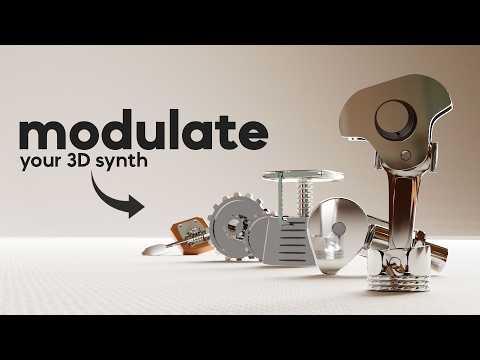
Mezeske’s own favorite addition is the Modulosphere, a sphere that can float through the scene and change whatever it touches. “Anukari has this whole 3D space, and the Modulosphere is the perfect expression of that,” he says. “It’s a way of shaping sound that only makes sense in three dimensions. It really takes advantage of Anukari’s virtual 3D world in a unique way.”
Big ideas in Anukari can mean big structures, and building them by hand can be painstaking. Version 1.1 adds tools that generate whole shapes and duplicate pieces in patterns. It also lets musicians bring their own AI assistant. Anukari has no AI built in, but anyone who already uses an AI assistant on their computer, such as Claude or ChatGPT, can now connect it to Anukari, describe the contraption they have in mind, let the assistant build it, and then see and hear the result in a fraction of the time.
“Some of the most fun things to make in Anukari are huge and complicated, and that can be incredibly involved,” Mezeske says. “If you already use an AI assistant, you can now point it at Anukari, describe whatever you’ve dreamt up, and hear how it sounds much sooner. There’s no AI inside Anukari; it just gives your assistant the controls. It’s a tool for exploring crazy ideas faster. And if you’re not a fan of AI, I completely respect that. You don’t need to use it. The new pattern duplication is super powerful on its own.”
To show off the new possibilities, 1.1 ships with more than 1,000 new factory presets across four new banks, including a collection of orchestral instruments built entirely from physics, along with a redesigned preset browser with search, filters, and favorites to make them easy to find. Playing has improved too, with legato and glide, editable envelope and velocity curves, and steady, incremental reductions in CPU use.
Since 1.0, Anukari has also arrived on Linux, fully supported alongside macOS and Windows, and gained gravity and turbulence controls that let structures fall, sway, and drift.
Anukari 1.1 is available now from anukari.com as a VST3, AU, AAX, and LV2 plugin, and as a standalone app for macOS, Windows, and Linux. It is a free update for all existing owners. To celebrate the release alongside Black Friday, Anukari is 50% off through December 4. The free 7-day demo has also been reopened for everyone, including people who already used up their trial on an earlier version, so anyone curious about what’s changed can try it again.
Watch the 1.1 release video: youtu.be/eS5KkCLxFXU
Watch how the Modulosphere was made: youtu.be/PexTyC0TBO4

Anukari works like a pocket universe, a parallel dimension that shares the laws of physics with ours, but uses them to create some of the coolest, quirkiest, and most evocative sounds of any virtual instrument or plug-in. The principles are simple, though the resulting sounds are delightfully complex: you conjure objects (masses, springs, mallets, bows) and place virtual mics, then play the mechanisms to generate amazing sounds.
Acting as both a virtual instrument and an effects processor, music makers can create sound-generating mechanisms or process external audio sources (like their voice or a guitar). They can record both audio and video directly within Anukari or use it as a plugin in their preferred DAW. They can drag and connect masses, springs, LFOs, envelopes and more.
After years in development and several months in beta, Anukari is now ready for everyone interested in sonic exploration as of June 23, 2026.
Built more like a game than an audio plug-in, Anukari’s visual and audio aspects are deeply entwined, a technological twist that changes how interaction unfolds. Anukari is visually malleable and its outputs shareable on socials, and it references the aesthetics of the internet’s glory days for a visually stunning environment to experiment in.
“I built Anukari for the intrepid sonic explorer. They may simply want to play and discover, or they may be a professional artist or producer looking for inspiration or a new sound to work with. Either way, I want people to push it, try to break it, and to see what surprises emerge in the process,” reflects Evan Mezeske, founder and creator of Anukari. “I thought it was cool, and I want to invite others to make cool shit. That’s really our whole mission.”
Anukari evolved organically from experiments Mezeske conducted in his spare time. A musician, serious autodidact, and a former engineering leader at Google, Mezeske had a long history of playing with tech, from figuring out how to run a simple game on his calculator in middle school to building his own version of Minecraft. Mezeske liked to explore how things worked by making them, and in the process, he became fascinated with translating real-world physics into virtual worlds.
“I grew up in my granddad’s autoshop surrounded by pistons and crankshafts. Perhaps because of that, I like machines and building things. Translating mechanical things into a simulation tickles that part of my brain that loves mechanical contraptions, and it makes playing Anukari feel different from other synths. Chips or transistors are very abstract, but with 3D graphics and physics, you see what it’s doing in real time, it’s tactile. ‘It’s jiggling like this and making a sound.’”
That love of mechanical systems led Mezeske to program a simple mass-and-springs 3D game more than a decade ago. “Once I built it, I wanted to see if it could generate audio. It did and the sounds were really neat,” he recalls. Over time, he became more and more intrigued with what might evolve from this first simple instance. What eventually emerged was Anukari.
Anukari’s visual and audio aspects are woven together, notes Mezeske: “Lots of people assume Anukari is an audio engine with a cute visualizer on top, but the reality is it wouldn’t work without the graphics. The 3D visuals make the audio happen, not the other way around.” While capable of a wild range of real-time manipulations, Anukari is remarkably stable and reliable. “Anukari is ridiculously efficient thanks to the way it’s designed. My past work at Google involved extremely large-scale systems, coordinating work across thousands of machines that have to cooperate,” says Mezeske. “What I had learned about distributed systems applied to building an audio plugin and coordinating things happening in parallel.”
Yet the technical aspects are all in service of the vision, of the excitement that led Mezeske to create Anukari, that feeling of discovering something new about how things work. “Exploration is often what captures us most in a certain kind of video game, the joy of exploring uncharted territory or solving a puzzle. For Anukari, the puzzle is ‘What can I get these 3D objects to sound like, what’s the next frontier I can cross?’ That’s why I built it and that’s what I hope everyone experiences when they play it.”
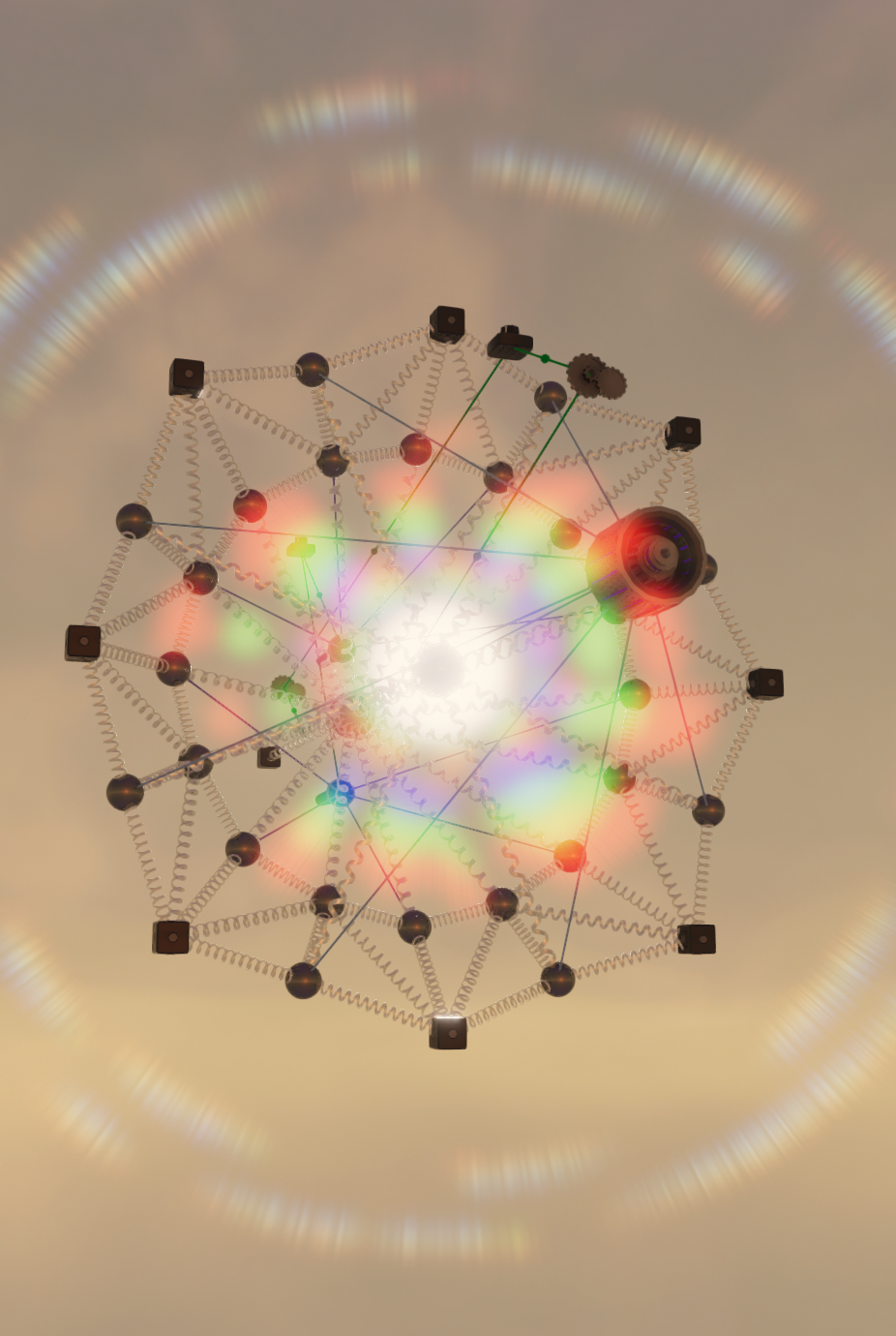
Free to use in coverage of Anukari. Click an image for the full-size file.
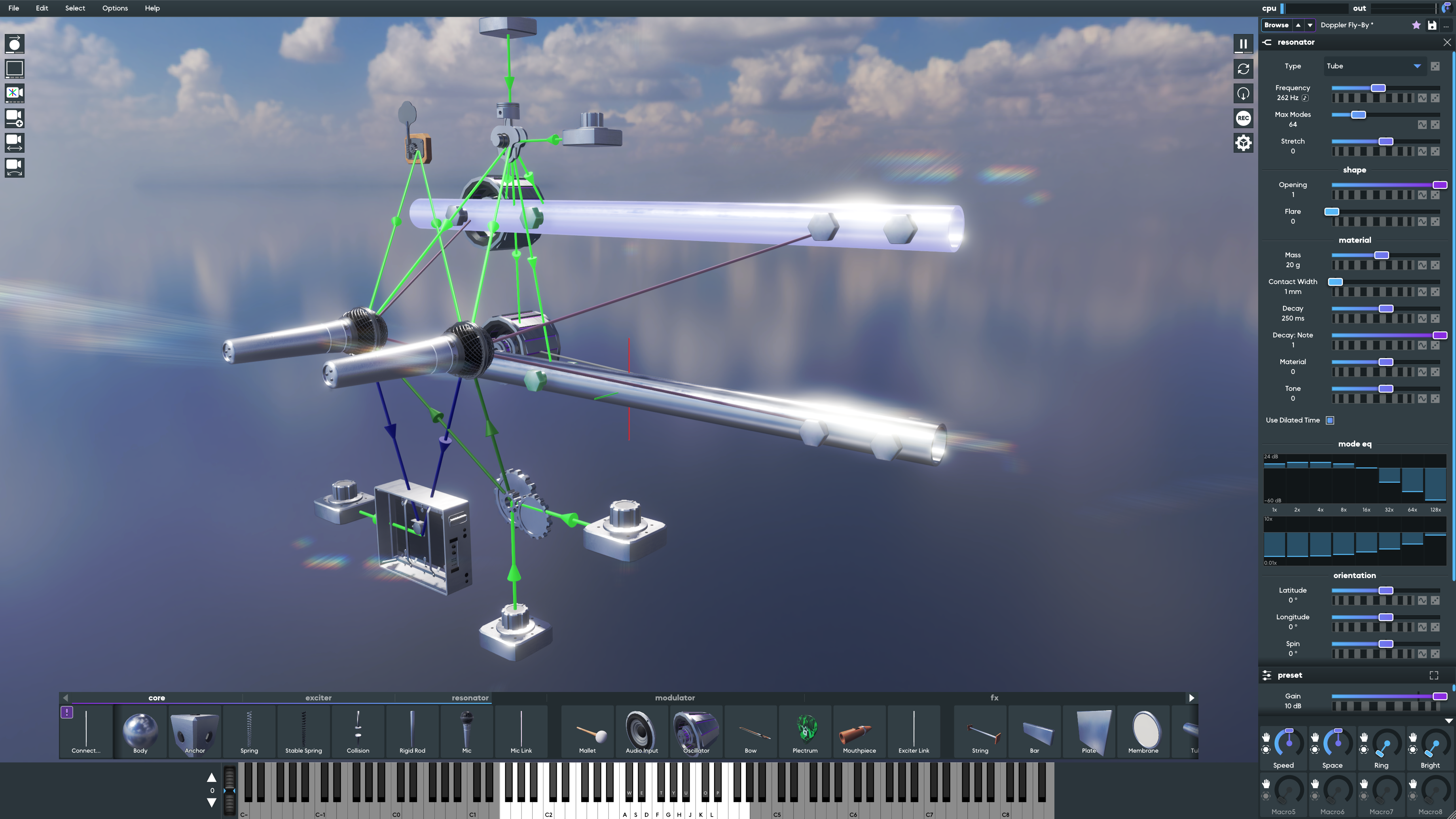
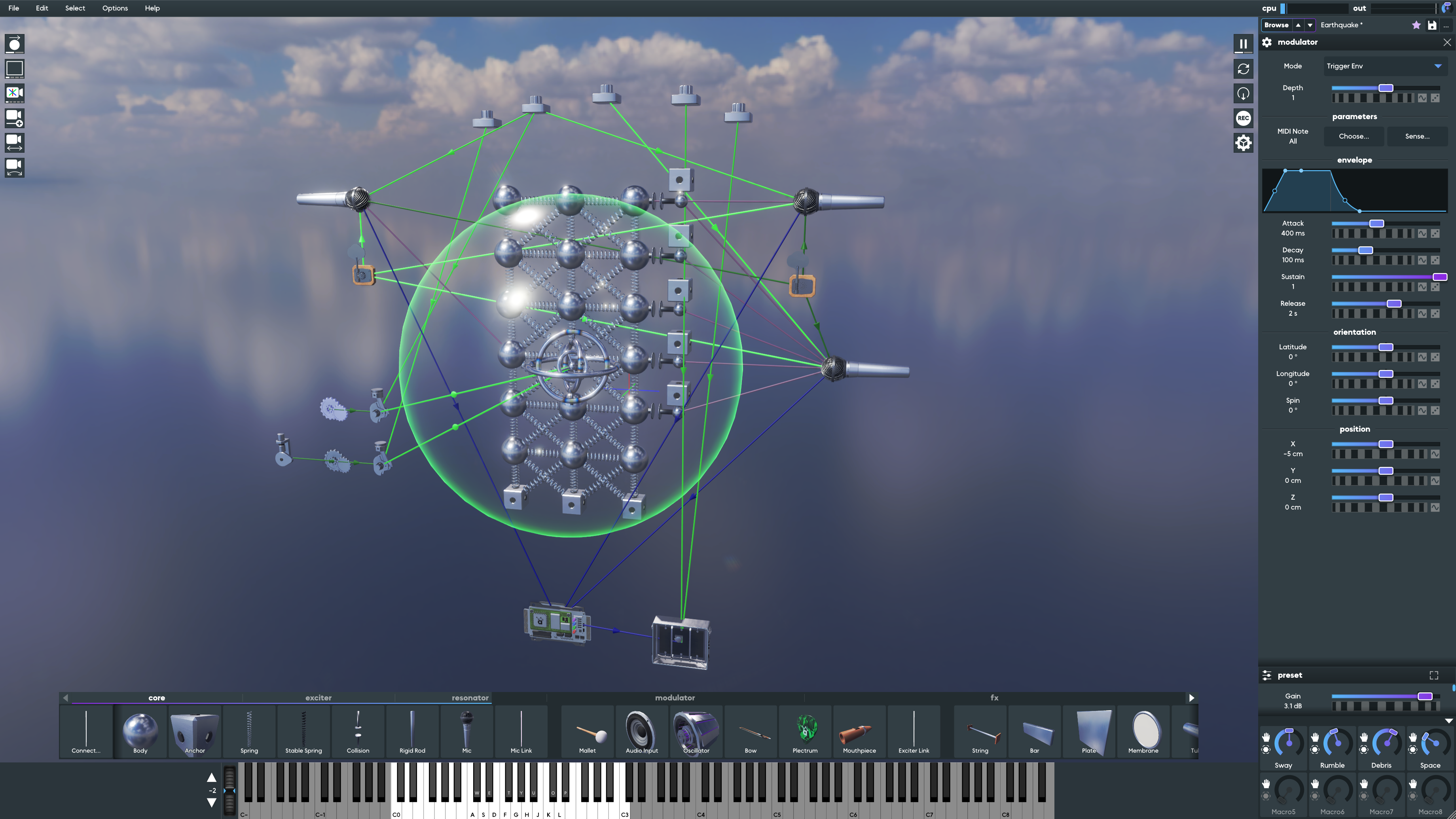
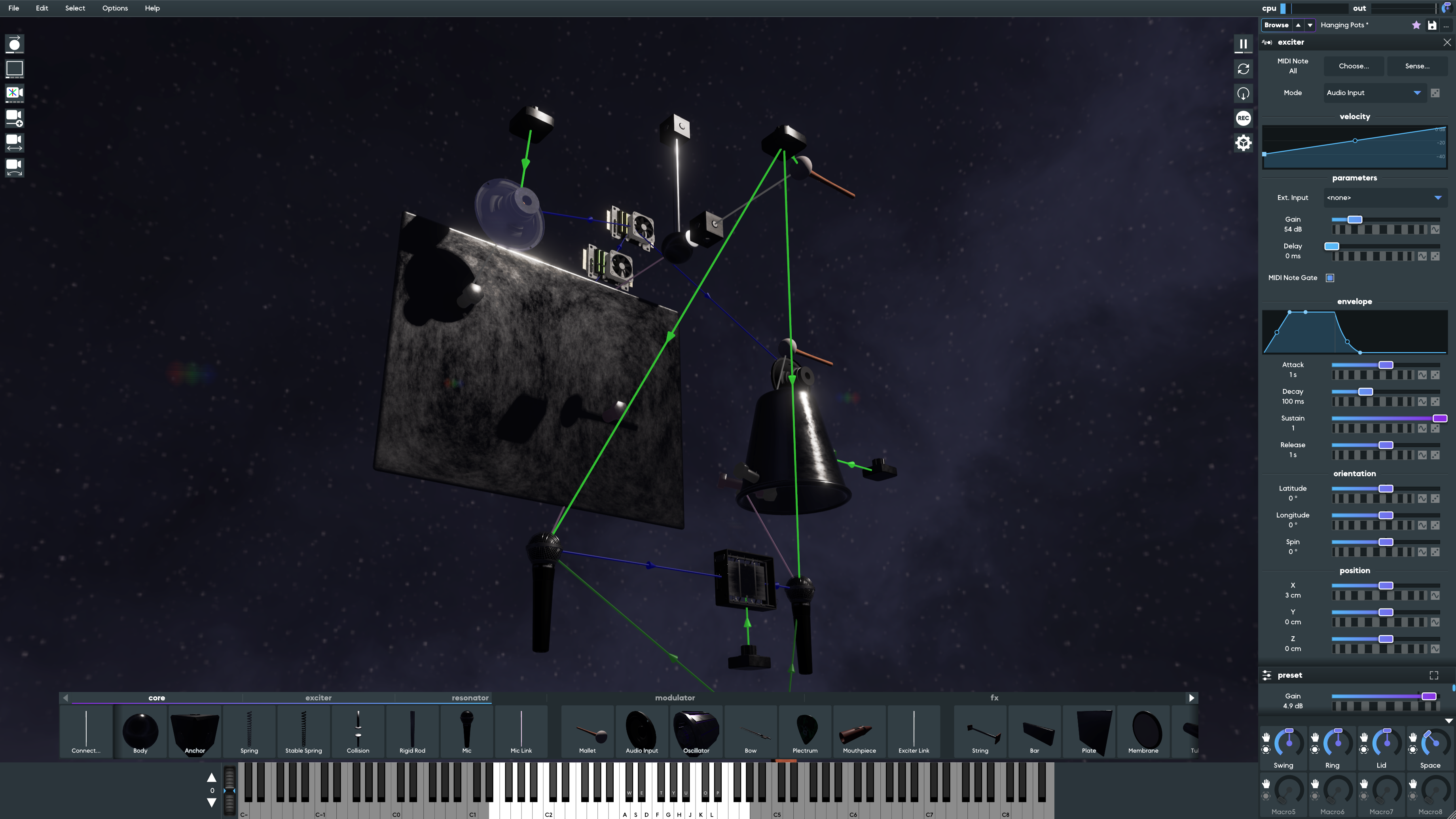
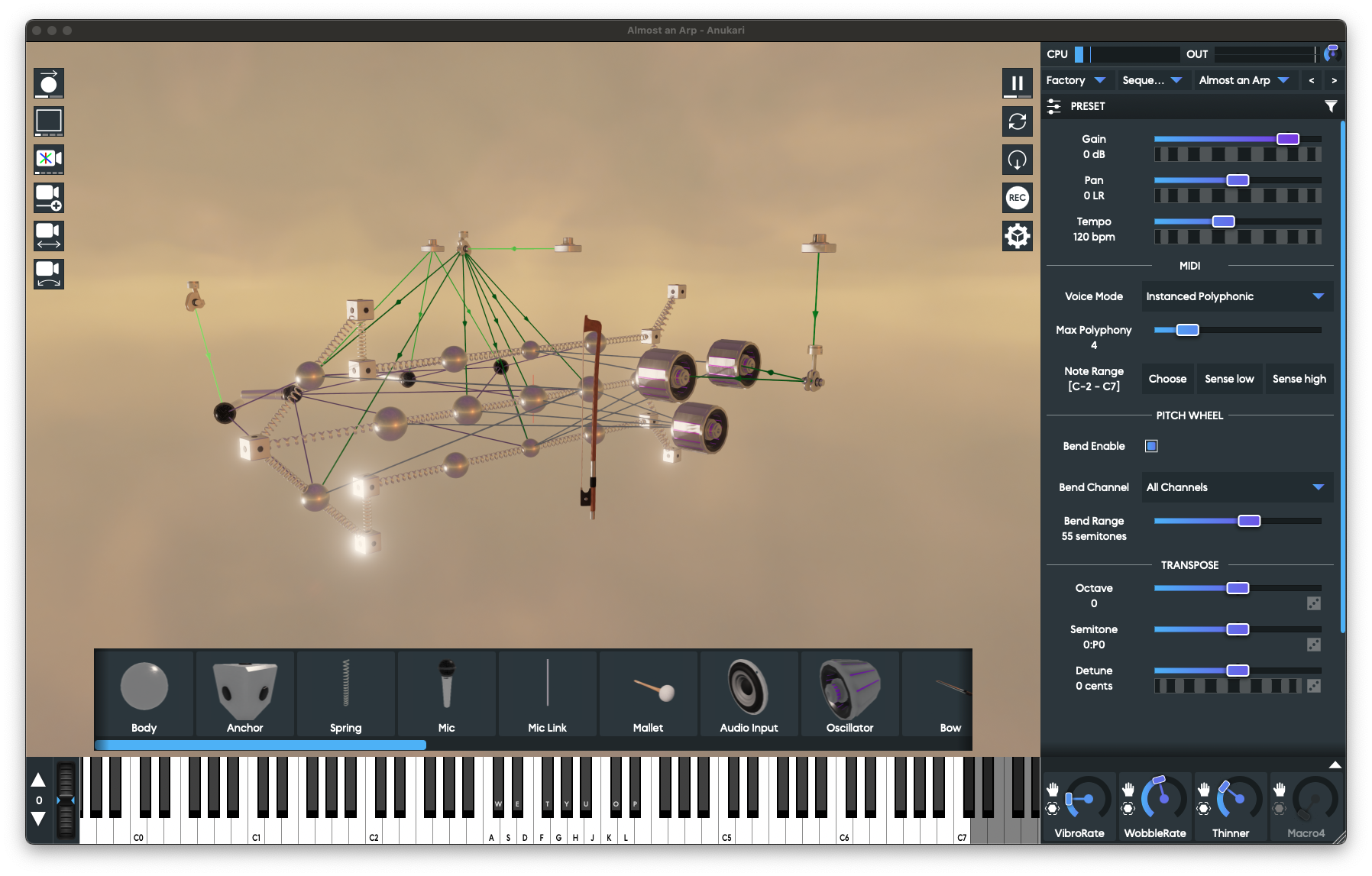
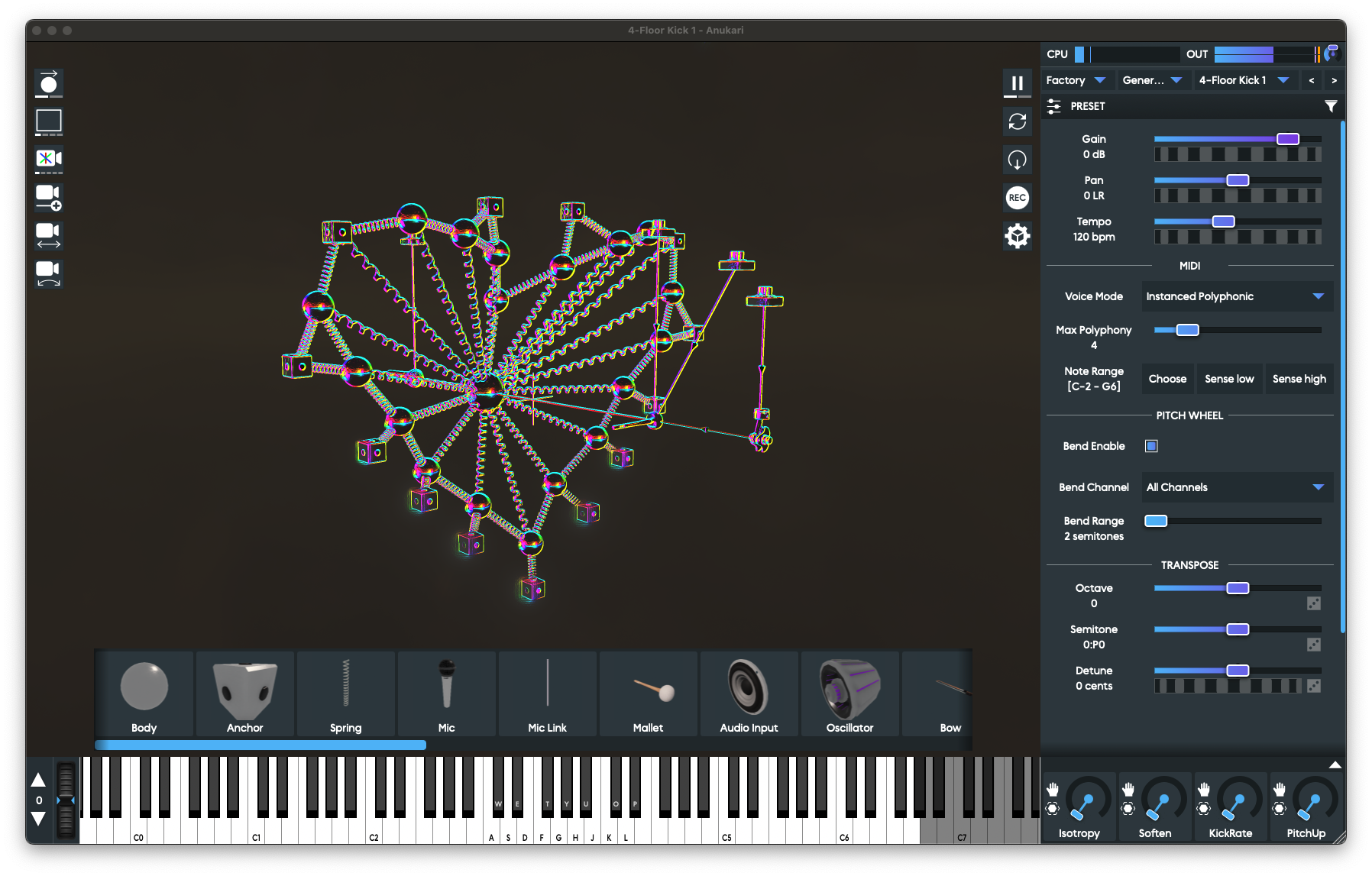
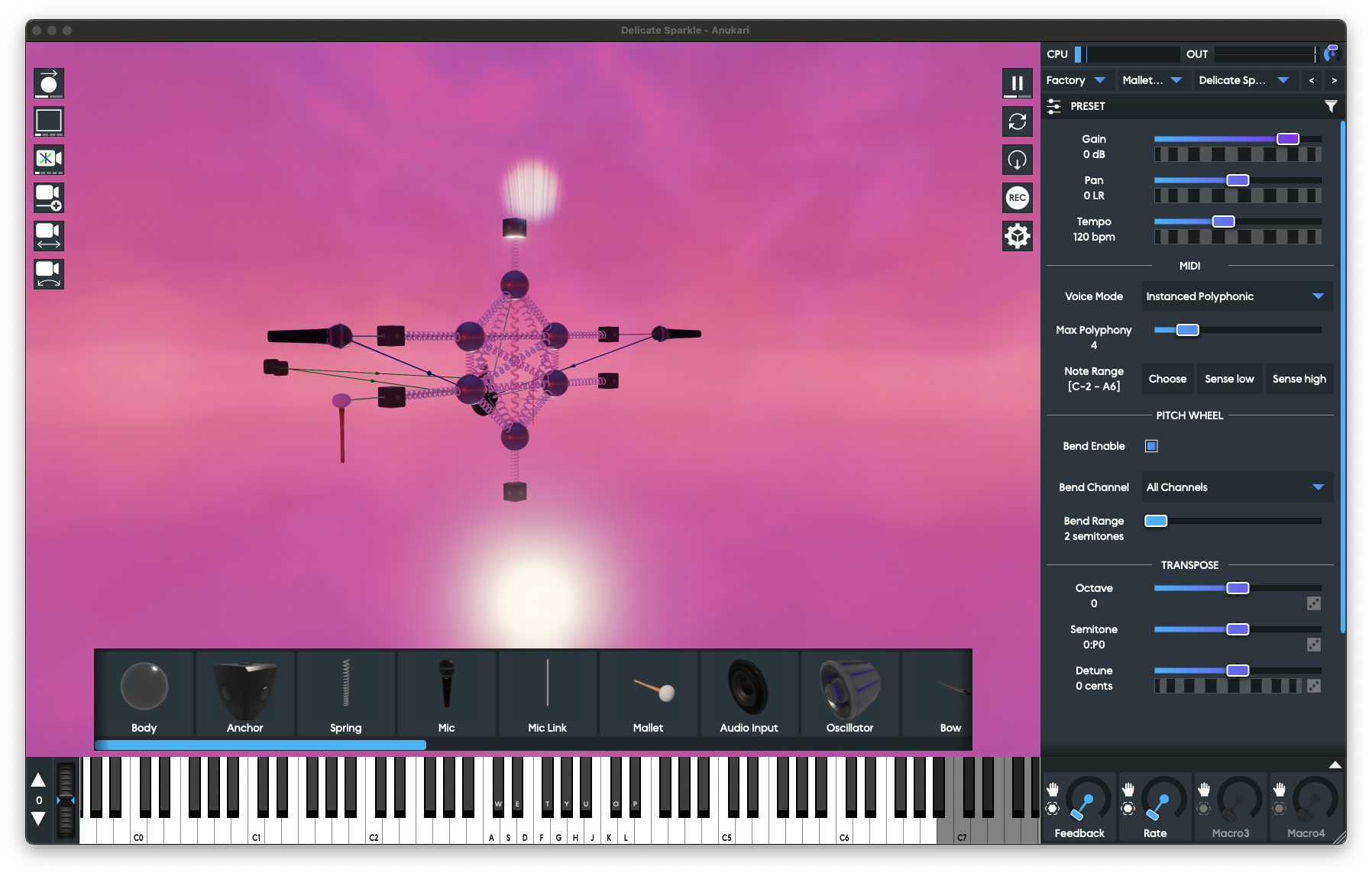
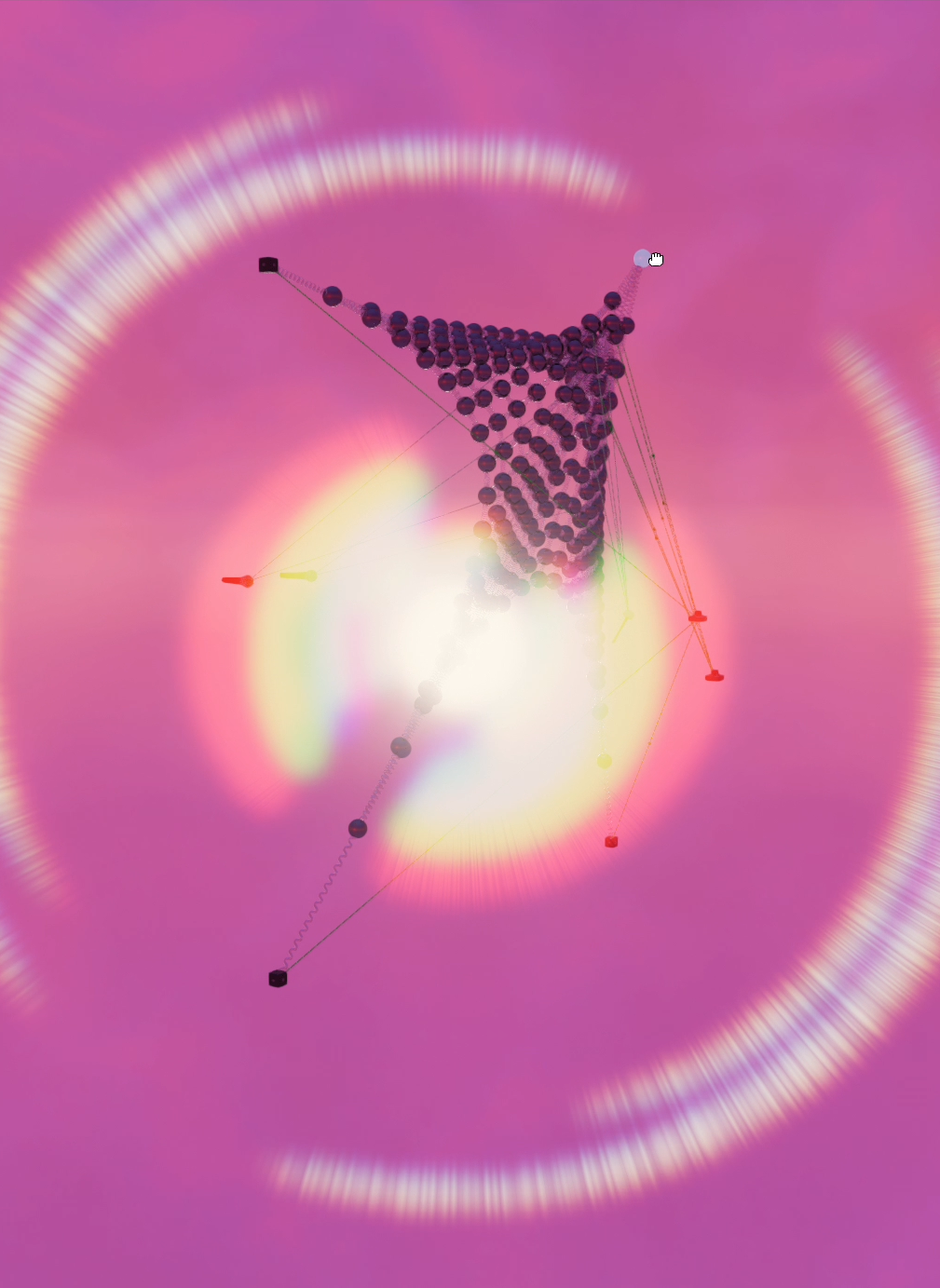
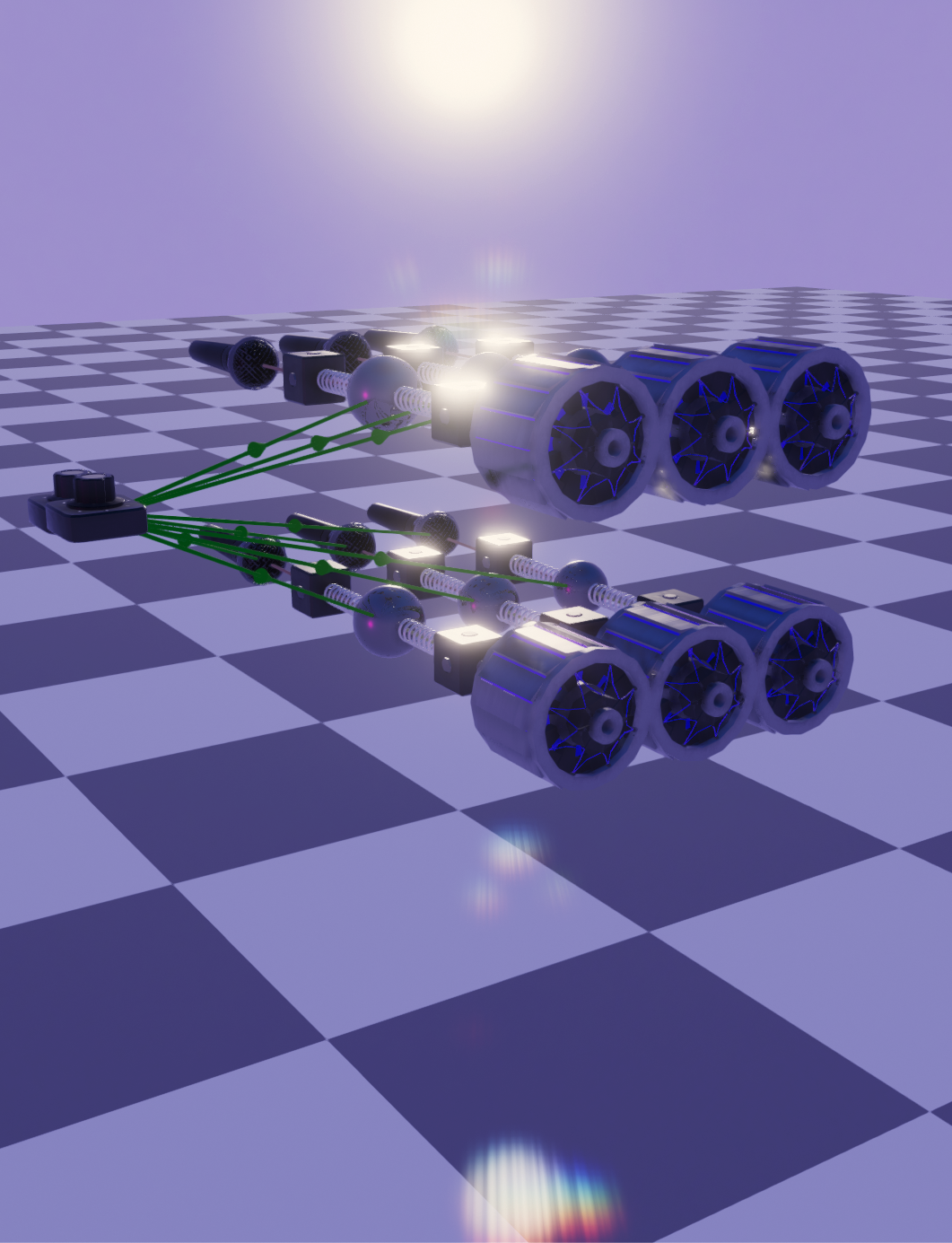


All videos can be embedded. More on the Anukari YouTube channel.


Short pieces played entirely in Anukari.



A few things that happened along the way. The path to 1.0 post tells the whole story.
Anukari is a software synthesizer and effects processor that makes sound from a real-time 3D physics simulation: you build an instrument from masses, springs, and resonating strings, plates, and tubes, then strike, bow, pluck, or blow it.
Anukari is a software synthesizer and audio effects processor that generates sound using a real-time 3D physics simulation. Instead of traditional oscillators, users build their own instrument in a 3D space from masses, springs, and resonators (strings, bars, plates, membranes, tubes, and bells), play it with mallets, bows, plectrums, a mouthpiece, or any audio input, and place virtual microphones around it to capture the sound. Effects, LFOs, and envelopes are objects in the same world, so they can shape and feed back into the physics. Working with it is closer to building with Lego or running a science experiment than to turning knobs on a synth. It runs as a standalone app or as a VST3, AU, AAX, or LV2 plugin on macOS, Windows, and Linux.
Evan Mezeske is the founder and creator of Anukari. A musician and former engineering leader at Google, he started Anukari as a spare-time experiment: a mass-and-spring 3D game that he wondered might also make sound. He has worked on it full time since 2023, and spoke about its engine at the Audio Developer Conference (ADC) in London that year.
Evan Mezeske grew up in his granddad’s auto shop, surrounded by pistons and crankshafts, and has been building things to see how they work ever since, from a game on his calculator in middle school to his own version of Minecraft. A musician who taught himself physics, he spent more than a decade at Google building large-scale software systems and leading engineering teams.
In the early 2010s he wrote a small mass-and-spring 3D game and wondered whether it could make sound. It could, and the collisions, resonance, and tension produced sounds unlike any traditional instrument. In 2023 he left Google to turn that experiment into Anukari full time, and spoke about its engine at the Audio Developer Conference in London that year.
“Very well deserved, in my opinion. It’s such a cool program.”
“Each instance is its own Newtonian universe ready to create harmony, chaos or a bit of both. The most open ended synthesizer there's ever been.”
“Anukari is a physical modeling synth that I've been hoping for for like a decade. Simulating physical structures to generate/affect sounds is so cool! Hard to get more ‘physical modeling’ – the next level up would just be to … make a physical model.”
“Yo Anukari is sick.”
“A unique, ambitious, and absolutely mental plugin.”
“There’s some stuff I got out of Anukari that I just have not been able to do with any other plugin.”
“What I like about Anukari is how unique it is.”
“Weirdly addictive.”
For interviews, questions, or anything else about Anukari:
Evan is available for interviews and live demos.
Writers, reviewers, and video creators can get a free not-for-resale license. Email the press address with your name, the outlet, and a link to your work.
Content creators interested in a paid collaboration are welcome to get in touch at the same address.